

By Sonance Lab
Turning cardboard
into healthy soil.
Cardboard Cruncher enriches compost with carbon-dense cardboard chips — strengthening the ecology of waste and helping businesses turn what used to be trash into nourishment for the soil.
01 — Circular Impact
From waste, to resource.
Cardboard doesn't have to end up in a landfill. The output becomes soil enrichment, packaging filler, and farm-grade mulch.
California Senate Bill 1383 requires restaurants, grocery stores, hotels, and food distributors to separate organic waste from landfill trash — diverting it through composting, anaerobic digestion, or other approved programs. Cardboard Cruncher enriches that compost with carbon-dense cardboard chips, strengthening the whole ecology of waste and helping businesses turn what used to be trash into nourishment for the soil.

Crunch
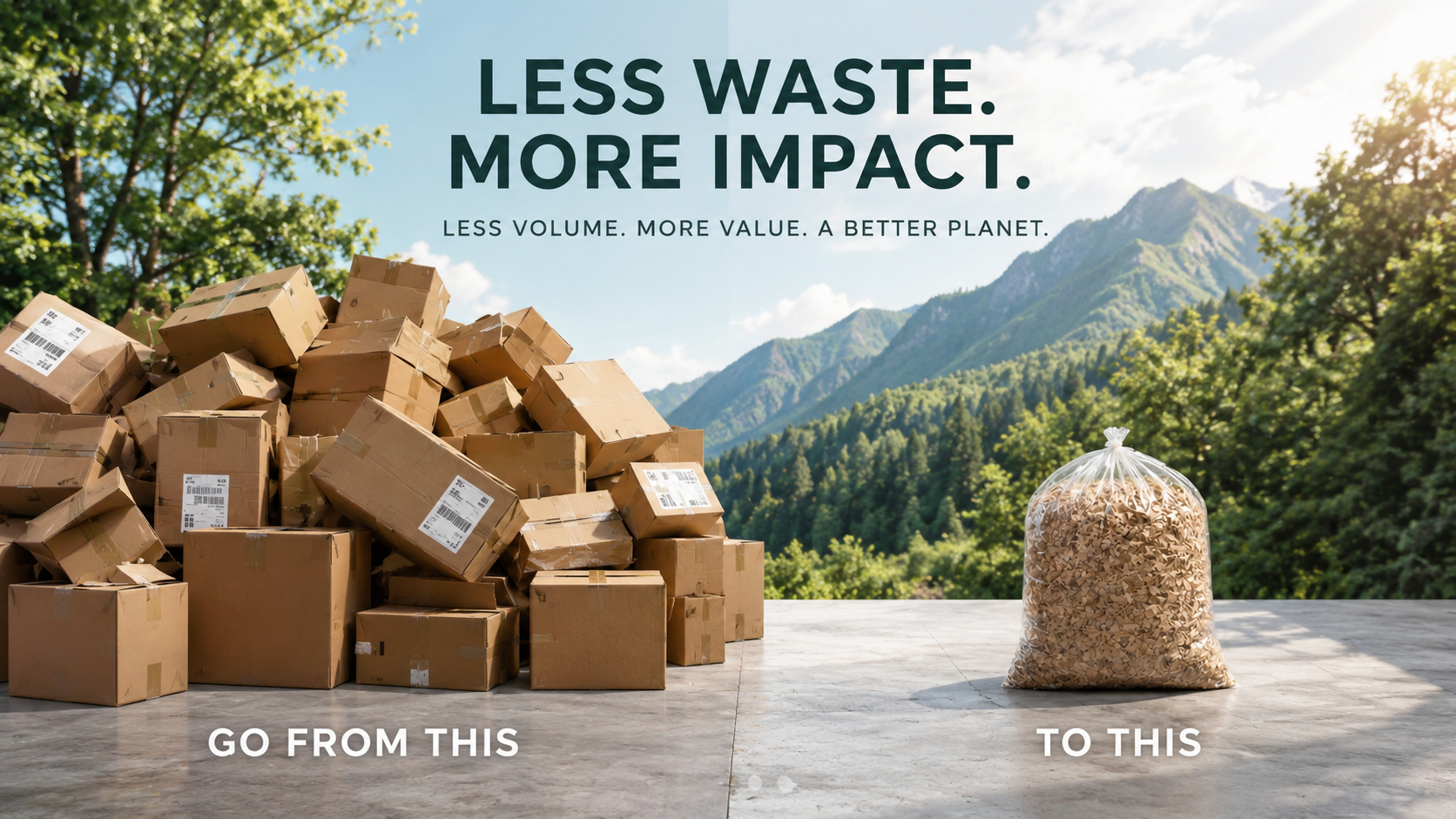
Reduce volume up to 10:1 on site.
Collect
Clean shredded output, ready to move.
Deliver
Local farms receive nutrient-rich mulch.
Renew
Healthier soil. Less landfill. Full circle.

The Cardboard Cruncher
The key to healthier soil.
The Cardboard Cruncher transforms cardboard into carbon-dense chips that feed compost, enrich soil, and help complete the cycle from waste to renewal.
New to shredding boxes for compost? Start with our cardboard shredder guide.
02 — Our Vision
Better Soil.
Better Food.
Better Future.
- Design should serve nature, not replace it.
- Convenience and responsibility are not opposites.
- The best waste is the kind that never existed.
03 — Possibility
A different future for cardboard.
Cardboard Cruncher transforms used cardboard into valuable organic material that can support composting, enrich soil, and contribute to healthier gardens and farms.
What was once clutter becomes a resource.
What was once discarded becomes useful again.
What was once waste becomes part of a natural cycle of renewal.
04 — The Cycle
From box to soil.

Every package tells a story. A box arrives, its contents become part of your life, and the cardboard becomes part of the earth.
Cardboard is made from trees. Trees grow from soil. Healthy soil grows healthy food.
The cycle is already there — Cardboard Cruncher simply helps complete it.
05 — Philosophy
Designed for regeneration.
- Compact cardboard.
- Less waste.
- More compost.
- Less clutter.
- More space.
- More purpose.
Because nature has never operated on a linear system.
Nothing is wasted.
Everything becomes something else.
06 — What's Next
The future is circular.
The future is not about eliminating convenience.
It is about designing better outcomes.
A future where deliveries still arrive, families still enjoy modern convenience, and the materials that support our lives are returned to the natural systems that sustain them.
07 — Questions
Composting, answered.
Can you compost cardboard?+
Yes. Plain corrugated cardboard is a carbon-rich 'brown' that composts well once tape and heavy inks are removed. Shredding it first dramatically speeds up decomposition.
How does the Cardboard Cruncher help with composting?+
It shreds boxes into small, uniform pieces with far more surface area, so microbes break them down faster. The same output also drops straight into a curbside recycling stream.
How much shredded cardboard should I add to a compost pile?+
Aim for roughly two to three parts shredded cardboard to one part nitrogen-rich food scraps by volume, then keep the pile moist and aerated.
Does shredded cardboard improve soil?+
Yes. As it breaks down it adds organic carbon, improves moisture retention and structure, and feeds the soil biology that supports healthy plants.
Can shredded cardboard be used as mulch instead of compost?+
It can. Shredded cardboard works as a weed-suppressing mulch around beds and trees, and as farm-grade bedding and packaging filler.
What is the best cardboard shredder for compost?+
The best cardboard shredder for compost produces small, uniform pieces of plain corrugated board without tape or heavy ink. The Cardboard Cruncher is built for exactly that: CBC Mini suits home compost setups, while CBC Pro Standard and Pro Heavy handle restaurant and farm-scale volumes.
How long does shredded cardboard take to compost?+
Shredded cardboard typically breaks down in roughly one to three months in an active, moist, well-aerated pile, compared with six months or more for whole flattened boxes. More surface area means faster microbial breakdown.
Cardboard waste, reimagined.
Because the best systems don't create waste.
They create renewal.

Cardboard Cruncher by Sonance Lab
Related Stories
From box to garden bed.
Read how shredded cardboard becomes bedding, mulch, and finished compost for the people already closing the loop at home.
Commercial
What operators say after the first month
Property managers and retail teams describe how much time and dumpster space the Cardboard Cruncher gave back.
Read the storiesResidential
Homeowners on living with less cardboard
Real households talk about breaking the delivery-box cycle and turning it into recycling and compost material.
Read the storiesVideo
See it in action
Short films of the Cardboard Cruncher at work, from loading a flattened box to collecting finished shred.
Read the stories