
Guide
How to choose a cardboard shredder.
A cardboard shredder is a machine that cuts corrugated boxes into small strips or pieces. Shredded cardboard takes up less space and is ready for recycling, compost, garden mulch, or packing filler. Here is how the different machines work and how to pick the right one for your space.
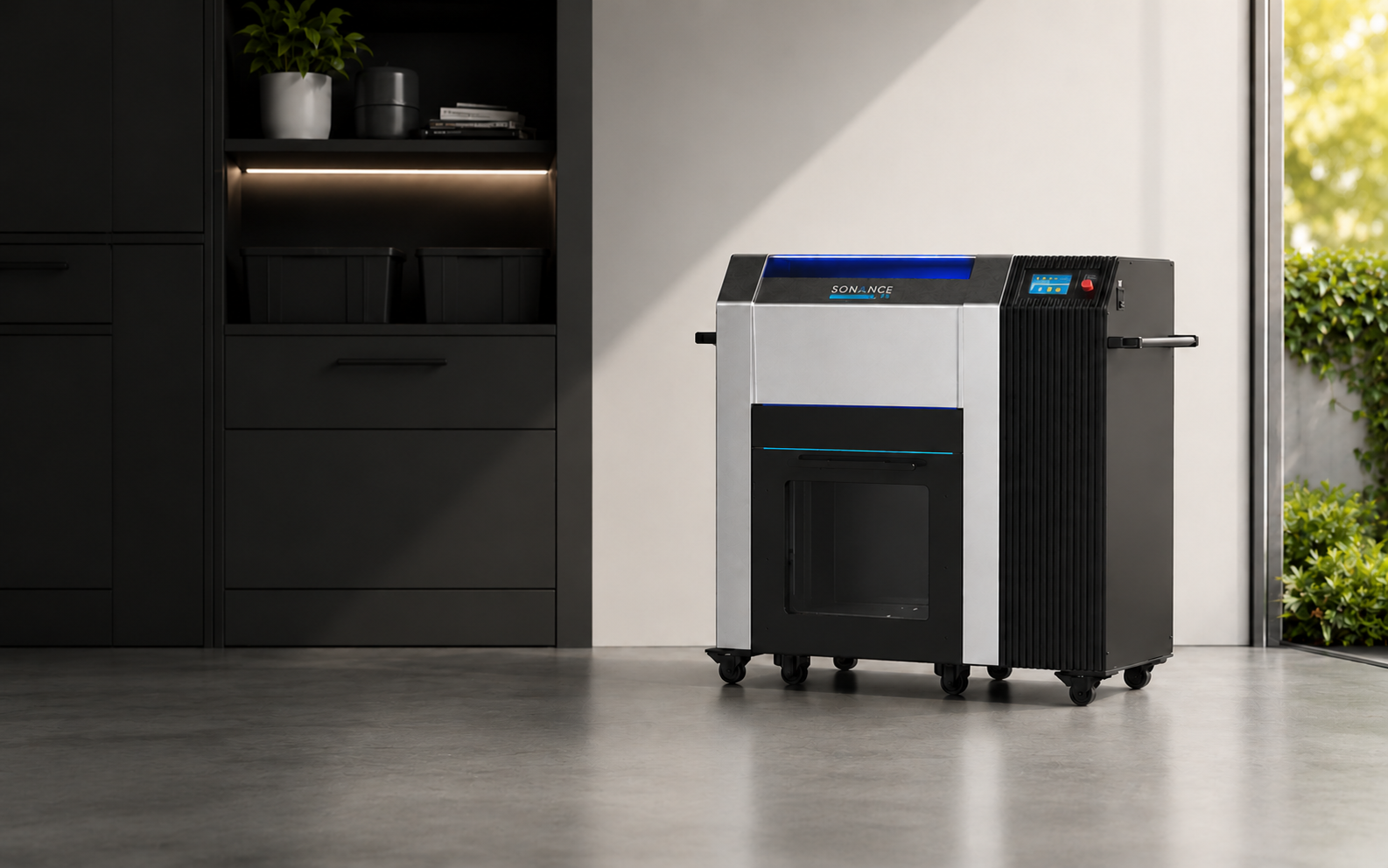
Quick comparison
| Option | Main job | Where it fits | Learn more |
|---|---|---|---|
| Cardboard Cruncher (Sonance Lab) | Cuts cardboard volume by up to 10 to 1 and makes output for recycling, compost, garden mulch, or packing filler | Homes, estates, studios, offices, warehouses. Several models run on a standard 110V outlet; Pro Heavy needs 220V | Cardboard Cruncher |
| HSM ProfiPack cardboard shredders (sold by sellers such as Whitaker Brothers) | Turn boxes into cushioning packing material | Shipping departments and packaging operations | HSM and Whitaker |
| Cardboard perforators such as Formax Greenwave | Cut a pattern into cardboard to make flexible packing netting | Shipping and warehouse work | Shredder vs perforator |
The right choice depends on whether you mainly need packing material or less cardboard taking up space.
Jump to: how to choose a cardboard shredder, Lux, Pro Standard, Pro Heavy, Industrial, Composting
The basics
What a cardboard shredder actually does.
A cardboard shredder cuts corrugated boxes into small, uniform pieces. That simple step changes everything about what happens next. Whole boxes are bulky, slow to break down, and awkward to store or haul. Shredded cardboard is compact, easy to handle, and ready for its next life.
The Cardboard Cruncher reduces cardboard volume by up to 10:1, so a week of packaging fits in a fraction of the space. The output drops straight into a recycling stream, a compost pile as carbon-rich browns, garden mulch, or packaging filler.
Types of cardboard shredders.
People use the words cardboard shredder for a few different machines. Here is what each one is for.
- Volume reduction shredders, like the Cardboard Cruncher. Built for the place where boxes pile up. They cut cardboard down so it takes less room, and the output goes to recycling, compost, garden mulch, or packing filler.
- Packing material shredders, like the HSM ProfiPack line. Built to turn boxes into cushioning for shipments in shipping and warehouse settings.
- Cardboard perforators. Cut a pattern into cardboard to make flexible packing netting.
- Heavy duty paper shredders. Some home composters cut thin boxes into strips and feed them through. Most household paper shredders are not built for corrugated board.
- Garden chipper shredders. Some gardeners who already own one use it for cardboard too. They are built mainly for yard waste.
If your main goal is less cardboard taking up space, start with a volume reduction shredder. If your main goal is padding for shipments, look at packing material shredders or perforators.
Why it matters
Why shredded cardboard beats whole boxes.
Recycling: shredded cardboard takes up far less room in bins and trucks, which means fewer pickups and less space lost to stacked boxes.
Composting: plain corrugated board is a carbon-rich brown material. Shredding increases surface area so microbes break it down faster, and it balances nitrogen-rich food scraps in the pile. Our composting guide covers ratios and timing in detail.
Reuse: the same output works as protective packaging filler, weed-suppressing garden mulch, and farm-grade bedding.
Choosing by space
Match the machine to the room.
The right cardboard shredder is the one that fits where your boxes actually pile up. Every Cardboard Cruncher runs quietly and produces the same recycling and compost-ready output.
Apartments and compact homes
The compact Cardboard Cruncher fits mudrooms, pantries, and laundry rooms, plugs into a standard outlet, and doubles as a document shredder.
See the Cardboard CruncherEstates and multi-family properties
The Lux pairs stainless steel construction with higher capacity for homes and properties where volume meets design standards.
See the LuxStudios, offices, and retail back rooms
The Pro Standard rolls where the cardboard arrives and disappears into a back office or package room.
See the Pro StandardWarehouses and high-volume operations
The Pro Heavy handles the largest loads, and our industrial shredder serves facility-scale throughput.
See the Pro HeavyCompare the full lineup on the Cardboard Cruncher models page.
Know the difference
Cardboard shredder vs cardboard perforator.
These two machines sound alike, but they do different jobs. A cardboard shredder cuts boxes into strips or small pieces. A cardboard perforator cuts a pattern into cardboard to make flexible netting or padding for packing.
If you want less cardboard to store and haul, a shredder is the tool. If you mainly want to turn boxes into padding for shipments, a perforator is built for that.
Comparing options
How the Cardboard Cruncher compares to HSM and Whitaker Brothers options.
Whitaker Brothers is a United States equipment supplier, in business since 1945, that sells cardboard shredders and perforators made by brands such as HSM, Formax, and Intimus. It is a seller, not a single machine. A few of the machines it lists:
- HSM ProfiPack C400: listed as taking 1 layer of cardboard (about 3/8 inch) with a 16.3 inch throat. It turns boxes into cushioning packing material and is positioned for shipping departments.
- HSM ProfiPack P425: listed as taking 2 to 3 layers (about 0.75 inch) with a 16.75 inch throat, positioned for higher volume packaging operations.
- Formax Greenwave 410 and 430: cardboard perforators that make flexible packing netting.
These machines are mainly built to make packing material for shipping and warehouse work.
The Cardboard Cruncher reduces cardboard volume by up to 10:1, and its output goes to recycling, composting, garden mulch, or packaging filler. It runs quietly. The compact Cardboard Cruncher, the Lux, and the Pro Standard plug into a standard 110V outlet, and the Pro Heavy needs 220V. Models are sized for homes, estates, offices, and warehouses.
The honest difference: HSM style machines focus on making packing material in shipping and warehouse settings. The Cardboard Cruncher lineup is designed around where boxes pile up, including homes, and around recycling and compost ready output. The right choice depends on whether you mainly need packing material or less cardboard volume.
Competitor details are from public product listings as of September 2026. Check with the seller for current specs and pricing.
Checklist
How to choose a cardboard shredder.
- Where do the boxes pile up? A mudroom, garage, back office, or loading dock each call for a different size of machine.
- How many boxes a week? A few deliveries fit a compact home model. Daily shipments point to the Pro Standard or Pro Heavy.
- What power outlet is available? The compact Cardboard Cruncher, the Lux, and the Pro Standard use a standard 110V outlet. The Pro Heavy needs 220V.
- What will you do with the output? Recycle it, compost it, use it as garden mulch, or reuse it as packing filler.
- Noise and space. Think about who shares the room and how much floor space you can give the machine.
See the models: compact Cardboard Cruncher, Lux, Pro Standard, Pro Heavy, and Industrial.
Questions
Cardboard shredder questions.
What does a cardboard shredder do?+
It cuts corrugated boxes into small, uniform pieces that are compact and easy to handle. The Cardboard Cruncher reduces cardboard volume by up to 10:1, and the output is ready for recycling, composting, garden mulch, or packaging filler.
Can I use a regular paper shredder for cardboard?+
Most household paper shredders cannot. Corrugated cardboard is thick and fibrous, and it jams or burns out motors built for office paper. A purpose-built cardboard shredder handles boxes a paper shredder cannot.
Is shredded cardboard good for compost?+
Yes. Plain corrugated cardboard is a carbon-rich brown material. Shredding increases surface area so it breaks down faster and balances nitrogen-rich food scraps. Remove tape and heavy inks first.
Which Cardboard Cruncher is right for my space?+
The compact Cardboard Cruncher suits apartments and small homes, the Lux fits estates and multi-family properties, the Pro Standard covers offices and retail back rooms, and the Pro Heavy handles warehouses and high volume operations.
Do cardboard shredders need special electrical work?+
The compact Cardboard Cruncher, the Lux, and the Pro Standard plug into a standard 110V outlet. Only the Pro Heavy requires a 220V plug for its larger motor.
Is a cardboard shredder the same as a cardboard perforator?+
No. A cardboard shredder cuts boxes into strips or small pieces. A cardboard perforator cuts a pattern into cardboard to make flexible netting or padding for packing.
Can I use shredded cardboard as packing material?+
Yes. Shredded cardboard works as packaging filler. The Cardboard Cruncher output can also go to recycling, composting, or garden mulch.
Should I choose a packing material machine or a Cardboard Cruncher?+
It depends on what you mainly need. Machines like the HSM ProfiPack are built to make packing material in shipping and warehouse settings. The Cardboard Cruncher lineup is designed around where boxes pile up, including homes, and around less cardboard volume with recycling and compost ready output.
How do you shred cardboard without a cardboard shredder?+
You can cut boxes into strips with a utility knife or tear them by hand. It works, but it is slow and the pieces come out uneven. A cardboard shredder makes small, even pieces that are easier to recycle, compost, or use as mulch.
What is the best cardboard shredder for home use?+
It depends on how many boxes you get and where they pile up. A few deliveries a week fit a compact home model. The compact Cardboard Cruncher, the Lux, and the Pro Standard all plug into a standard 110V outlet.
Ready to close the loop?
Explore the Cardboard Cruncher family and find the machine built for your space.